

Meet the Northern Cardinal: Vibrant, Bold, & Devoted

Updated: Oct 27
God's Small Wonders Series: The Northern Cardinal

Table of Contents
Introduction & Species Spotlight

I was blessed to see one of these beautiful birds outside my window a few weeks ago, and I couldn’t wait to write a blog about it. It was a male. With its eye-catching, vibrant red plumage and distinctive black-masked face, I find it to be one of God’s most beautiful small creations.
Unlike the male, the female Northern Cardinal has a softer plumage of brown with red accents. To me, she resembles a cute little hen.
Cardinals do not migrate, nor do they molt into a dull plumage. Because of this, they look amazing in winter against a beautiful snowy backdrop. But don’t let their small size fool you! They are highly visible, confident birds that often visit open feeders and are not easily intimidated by smaller species.
Cardinals will fiercely protect their space, especially during breeding season, and will relentlessly defend their territory from rivals. If you don't believe me, watch the video at the end of this post of a Cardinal and a Blue Jay going at it in a bird feeder!
Northern Cardinal Fast Facts
Scientific Name: Cardinalis cardinalis
Order: Passeriformes Family: Cardinalidae
Lifespan: Average of 3—5 years. The oldest wild Northern Cardinal lived to be 15 years and nine months in Pennsylvania.
Size: 8.3— 9.1 inches (21–23 cm) in length from beak to tail.
Weight: 1.5–1.7 oz (42–48 g).
Other Names:
Cardenal Norteño (Spanish)
Cardinal rouge (French)
Home & Habitat
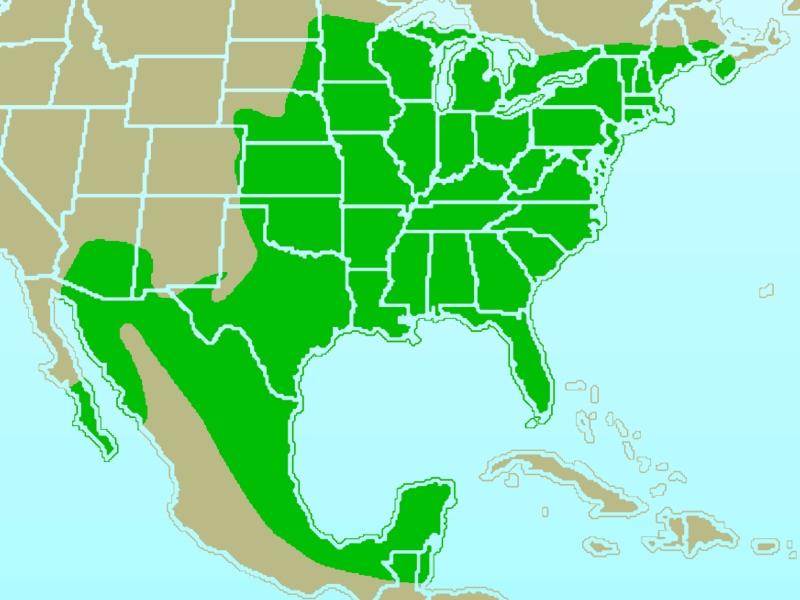
While the large majority of Northern Cardinals live in the United States, their native geographic range spans parts of five different countries across North America and Central America.
They populate the entire eastern half of the country—from Maine west to Minnesota and south to the Texas border. They are mostly absent west of the Rocky Mountains, though they are locally common in parts of the desert Southwest (like Arizona and New Mexico).
Humans introduced a few cardinals to a few isolated regions outside their native range, including the islands of Hawaiʻi, Bermuda, and southern California.
Northern Cardinals are strictly non-migratory. They do not fly south for the winter; instead, they live in the same territory year-round. In fact, most cardinals live their entire lives within a mile of where they were originally born.
Within these countries, they thrive in edge environments rather than deep, dense forests. You will usually find them in brushy shrublands, wetlands, backyards, suburban gardens, and parks.
Their range has actually been expanding steadily northward into Canada over the last century. Ornithologists attribute this expansion to rising global temperatures and the abundance of winter food from backyard bird feeders.
What’s On the Menu? (Diet and Foraging)

A cardinal’s diet consists mostly of seeds and fruit, which they supplement with insects.
Some common fruits and seeds include: wild grape, buckwheat, peanuts, grasses, sedges, mulberry, hackberry, blackberry, and corn. They will eat a variety of birdseed, especially black oil sunflower seed. Northern Cardinals will also eat beetles, moths, butterflies, spiders, centipedes, flies, cicadas, katydids, and leafhoppers.
Northern Cardinals forage on or near the ground. They like to sing and preen from a high branch of a shrub. When they are agitated, they raise their distinctive crest, and they lower it when they are resting.
During the breeding season, cardinals generally move around in pairs, but they can also form a large flock of a dozen to several dozen birds during the fall and winter months.
Songs & Sounds
Nothern Cardinals are song birds and both the male and the female sing. Their songs usually last 2–3 seconds. It is described as a "cheer, cheer, cheer or a birdie, birdie, birdie" sound (Cornell Lab, 2026). The males sing throughout the year, but the peak of sinGing is in spring and early summer.
Calls
At least 16 different calls for the Northern Cardinal have been described by scientists, but the most common is a loud, metallic chirp. Cardinals make this call to warn intruders away from their territory, when a predator is near, when a female is approaching their nests, and when both sexes carry food to the nest. They also make this call when they attempt to make a nestling leave the nest. A softer sound is make before one member of the pair feeds the other.
Love & Family (Mating and Nesting)

Northern Cardinals build their nests in small branches of a sapling, shrub, or a tangle of vine about 1–15 feet high, hidden in dense foliage. They use a variety of shrubs and trees, including honeysuckle, dogwood, hawthorn, red cedar, spruce, sugar maples, and pines.
The male and female cardinals visit possible nest sites together, about a week or two before the female starts construction. As they assess each site, they call back and forth, holding building material in their bills.
The female does most of the building, while the male oftentimes brings her nest material. Nests are open cups of coarse twigs and sometimes bits of trash. They are covered in a leafy mat and lined with grapevine, grasses, stems, rootlets, and pine needles. The finished product is 2–3 inches tall, 4 inches across, and has an inner diameter of roughly 3 inches.
Northern Cardinals typically only use their nest no more than once. They generally have 2–5 eggs and 1–2 broods. The incubation period is 11–13 days, and the nesting period is 7–13 days.
The eggs are grayish white, pale yellow, or greenish white, speckled with pale grey to brown. The nestlings hatch naked except for sparse clusters of greyish down. They are clumsy, and their eyes are closed.
The Northern Cardinal and the Blue Jay

If there are two birds that instantly bring a splash of color to a snowy winter backyard, it is the Northern Cardinal and the Blue Jay. Both are famous for their brilliant plumage, distinct head crests, and frequent visits to backyard feeders.
However, despite sharing similar neighborhoods across eastern North America, these two species couldn’t be more different. From their distinct family lineages—the Blue Jay belonging to the highly intelligent crow family, and the Cardinal belonging to the grosbeak family—to their drastically different social behaviors, comparing them reveals just how diverse our backyard wildlife truly is.
Let’s take a look at how they stack up side-by-side.
Feature | Northern Cardinal | Blue Jay |
Scientific Name | Cardinalis cardinalis | Cyanocitta cristata |
Primary Color | Brilliant red (males); warm/tan red (females) | Both male and female look identical with striking blue, white, and black plumage. They have a distinctive black “necklace” around their throats. |
Average Size | 8.3–9.1 inches (21–23 cm) | 9.8–11 inches (25–30 cm) |
Average Height | 1.5–1.7 oz (42–48 g) | 2.5–3.5 oz (70–100 g) |
Geographic Range | Eastern/Southwestern US, Mexico, and SE Canada | Eastern/Central US and Southern Canada |
Migration | Strictly non-migratory (resident year-round) | Partially migratory (some fly south) |
Core Diet | Seeds, grains, berries and insects | Acorns, peanuts, nuts, seeds, insects, and small vertebrates |
Feeder Personality | Bold, territorial, and peaceful with smaller birds | Loud, dominant, and cautious (they are known as the “bully” at the bird feeder |
Family Bond | Monogamous pairs; stay close to their mate | Highly social; live in family flocks |
Finding Beauty in the Balance
Ultimately, choosing a favorite between the Blue Jay and the Northern Cardinal is nearly impossible—and thankfully, we don’t have to. While the Blue Jay captivates us with its striking intelligence, complex social structure, and bold presence, the Northern Cardinal charms us with its devoted partnerships, fierce territorial loyalty, and unrivaled, brilliant color.
Both birds serve as a wonderful reminder of the vibrant biodiversity waiting right outside our windows. By putting out a diverse mix of seeds—sunflower and safflower—you can turn your backyard into a front-row seat to watch the fascinating dynamic between these two incredible species unfold.
References
American Bird Conservancy. (2025, December 17). Northern Cardinal - American Bird Conservancy. https://abcbirds.org/birds/northern-cardinal/
Audubon. (2019, March 21). Northern Cardinal. https://www.audubon.org/field-guide/bird/northern-cardinal
Cornell Lab: All About Birds. (2026). Overview, all about birds, Cornell Lab of Ornithology. (2026). https://www.allaboutbirds.org/guide/Northern_Cardinal/overview
The Bird Perch. (2024, July 17). Cardinal vs Blue Jay (dispute over the feeder)! [Video]. YouTube. https://www.yourtube.com/watch?v=Sopidjv5C18
Author's Bio
Welcome! I am a passionate nature lover who recently fell head over heels for the incredible world of avian wonders. Captivated by the vibrant color, unique behaviors, and gentle melodies of God's beautiful birds through Christ Jesus, I created this space to share that joy with you!
Through weekly stories, observations, and deep dives into different species, I hope to inspire you to pause, look up, and appreciate the magnificent feathered creatures all around us. Join me every week as we explore the skies and God's small wonders together!


Comments