

Meet The Blue Jay: Bold, Vocal, and Intelligent

Exploring the Beauty & Intelligence of God's Blue Jays
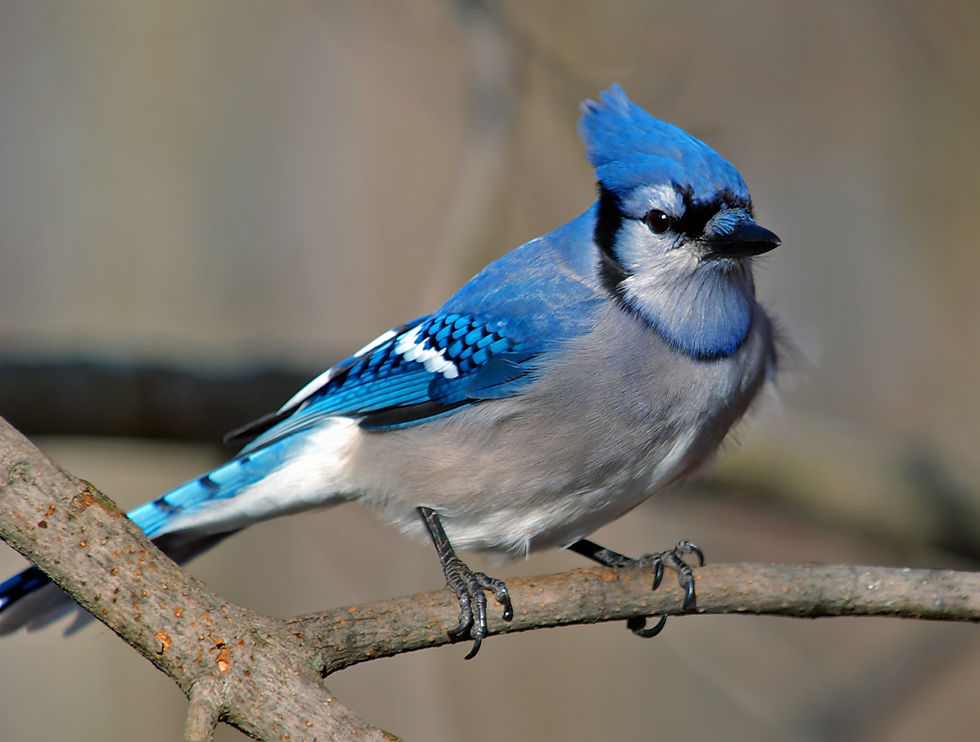
Species Spotlight
I am so in love with this large songbird, with its perky chest, spectacular blue plumage, and beautiful variety of calls; it is known for its intelligence, complex social systems, and tight family bonds. The Blue Jay is a master communicator with an extensive “vocabulary” and can mimic just about anything!
Fast Facts:
Scientific Name: Cyanocitta cristata. Order: Passeriformes. Family: Coridae.
Lifespan: Average of 7 years, though the oldest known wild Blue Jay, which had a band placed around its leg, lived for 26 years and 11 months.
Size (Both Sexes): 9.8–11.8 in (25–30 cm).
Weight: 2.5–3.5 oz (70–100 g).
Wingspan: 13.4–16.9 in (34–43 cm).
Other Names
Chara Azul (Spanish)
Geai bleu (French)
Home and Habitat
Blue Jays live near oak trees and are more abundant near forest edges than in the deep forest. They are common in both urban and suburban areas, especially near bird feeders and oak trees. You can find them in wood lots, towns, cities, and parks.
Unlike some birds, Jays are a bit mysterious when it comes to migration. They do not have a “set” pattern. Some stay all winter, while some individual birds migrate south once a year, stay north the following winter, and then migrate the next year. The young are more likely to migrate than adults, but many adults also migrate.
Although Blue Jays are common, their populations have declined. The main cause of death is cat and dog attacks.
What’s On the Menu? (Diet and Foraging)
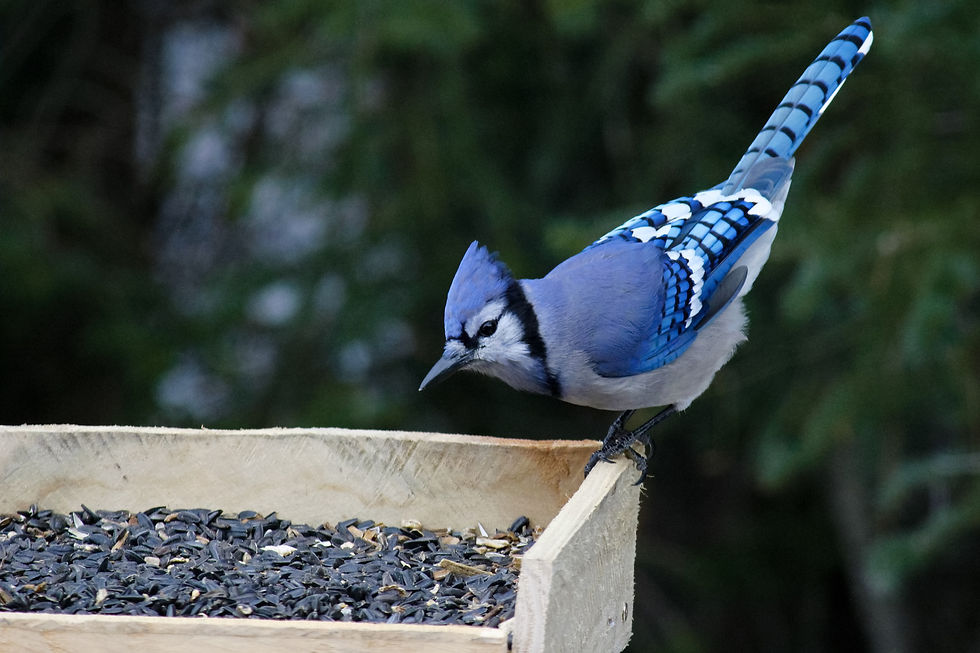
A Blue Jay’s diet includes insects, seeds, and nuts. They find these foods in trees, shrubs, and on the ground. They also eat grains, dead and injured small vertebrates, and sometimes they raid nests for eggs and nestlings.
Jays like acorns and sunflower seeds. They collect food items in their throat pouch to stash elsewhere. When they eat, they hold seeds with their feet and peck them open.
Blue Jays prefer hopper or tray feeders on a post over a hanging feeder. They prefer peanuts, sunflower seeds, and suet. They usually take drinks from birdbaths.
Blue Jays are not known to use tools; however, captive birds have used newspaper strips to rake food scraps from outside their cages.
Love & Family (Mating and Nesting)
Blue Jays build their nests in the thick outer branches of a coniferous or deciduous tree, typically 10–25 feet above ground. Both male and female collect materials and build the nest; however, the male does most of the gathering, and the female does most of the building.
Nests are open cups of grass, twigs, and mud, lined with rootlets. Blue Jays sometimes fly long distances to obtain building materials from recently dug ditches, fresh graves in cemeteries, and newly fallen trees.
Jays are fiercely territorial and will aggressively defend their young and nest from threats. However, if a predator is nearby and persistent, Blue Jays will abandon their nest after doing everything to protect it.
Jays are highly intelligent with complex social systems. They have close family bonds and often mate for life, staying with their mate for the remainder of the year.
The female incubates, and the male provides the food during incubation.
The eggs are bluish or light brown with brownish spots. New Blue Jays are born naked and helpless. Their eyes are closed, and their mouth lining is red.
After the nestlings hatch, the male gathers food for his mate and babies for the first 8–12 days while the female broods. After this, females share in the gathering, but males continue to bring more food than females.
The young remain in the nest and are fed by their parents for one to two months.
Communication & Behavior
Blue Jays are master “impersonators” and often mimic hawk calls, especially the Red-shouldered Hawk. These calls are believed to warn other Jays of a nearby Hawk or provide other information. Scientists believe that Blue Jay use the hawk call to trick other species into believing a hawk is present.
Blue Jays have a large “vocabulary” and can also mimic people. Captive birds have learned to imitate meowing cats, human speech, and other species.
Blue Jays use both vocal calls and physical movements of their crests to communicate. When they are feeding, incubating eggs, or interacting calmly with family members and their flock, they keep their crest lowered. A flatter crest indicates a more peaceful, non-aggressive state, whereas a raised crest signals heightened aggression.
When Blue Jays squawk, the crest is always up.
Beginning Scouting Tips
Do you want to see a Blue Jay for yourself? Look & listen for these clues:
Songs: Blue Jays most often sing a “whisper song,” described as a soft, quiet collection of chirps, whines, and elements of other calls. Their singing can last longer than 2 minutes.
Calls: They have a large variety of calls. The most common one is a loud jeer. Blue Jays also whistle notes and gurgling sounds.
Other Sounds: When aggressive, Blue Jays snap their bills. If they are caught in a trap, they might peck their beak loudly on a perch.
Not to Be Confused With
Many people confuse the Blue Jay with the Steller's Jay. The main differences between these two birds are their physical coloring, where they live, and their behavior. Please see the pictures and the chart below:

Feature | Blue Jay | Steller’s Jay |
Appearance | Bright lavender-blue back, white chest and belly, and a distinct black necklace around the throat. | Dark charcoal-black head, neck, and upper back that blend into a rich blue body. |
Crest | Light blue crest | Prominent, long, shaggy black crest. |
Geographic Range | Found primarily in the eastern and central United States and southern Canada. | Found in the western United States and Central America. |
Habitat | Prefers deciduous forests, suburban backyards, and city parks. | Prefers dense evergreen pine and coniferous forests in mountainous regions. |
Behavioral Differences
While both birds are highly intelligent, loud, and belong to the same corvid family (which includes crows, magpies, and ravens), the Blue Jay is much more common in suburban areas and often visits backyard bird feeders. The Steller’s Jay is bolder and more opportunistic in the wild, often stealing food from campsites and picnic areas in western parks.
Just like their relative, the Crow, both species can recognize human faces and remember routines.
Conclusion
To me, birds in general are God’s beautiful and elegant “flowers of the sky”, and Blue Jays are just one of His spectacular masterpieces. Our Creator was truly showing off when he made this bird: its beautiful colors are breathtaking and a work of art. Much to my surprise, I recently saw one out my window, and I was so delighted!
The next time you see one of these magnificent birds, take a moment to appreciate its gorgeous blend of colors, watch its fascinating bold behavior, and listen to its beautiful, poetic vocalizations. You will be truly amazed.
Please check out this awesome YouTube video by Leslie the Bird Nerd: 5 Weird and Funny Things Blue Jays Do
Author's Bio
Welcome! I am a passionate nature lover who recently fell head over heels for the incredible world of avian wonders. Captivated by the vibrant color, unique behaviors, and gentle melodies of God's beautiful birds in Christ Jesus, I created this space to share that joy with you!
Through weekly stories, observations, and deep dives into different species, I hope to inspire you to pause, look up, and appreciate the magnificent feathered creatures all around us. Join me every week as we explore the skies together!

References
Blue Jay. (2016), Cornell Lab: All About Birds. https://www.allaboutbirds.org/guide/Blue_Jay/overview
Blue Jay life history. (n.d.). Cornell Lab: All About Birds. https://www.allaboutbirds.org/guide/Blue_Jay/lifehistory#nesting
Blue Jay sounds. (n.d.). Cornell Lab: All About Birds. https://wwwalaboutbirds.org/guide/Blue_Jay/sounds
Klein, C. (2026, March 9). 10 fun facts about the Blue Jay. Audubon. https://www.audubon.org/magazine/10-fun-facts-about-blue-jay
Lesley the Bird Nerd. (2023, October 22). 5 weird and funny things Blue Jays do [Video]. YouTube. https://www.youtube.com



Comments